

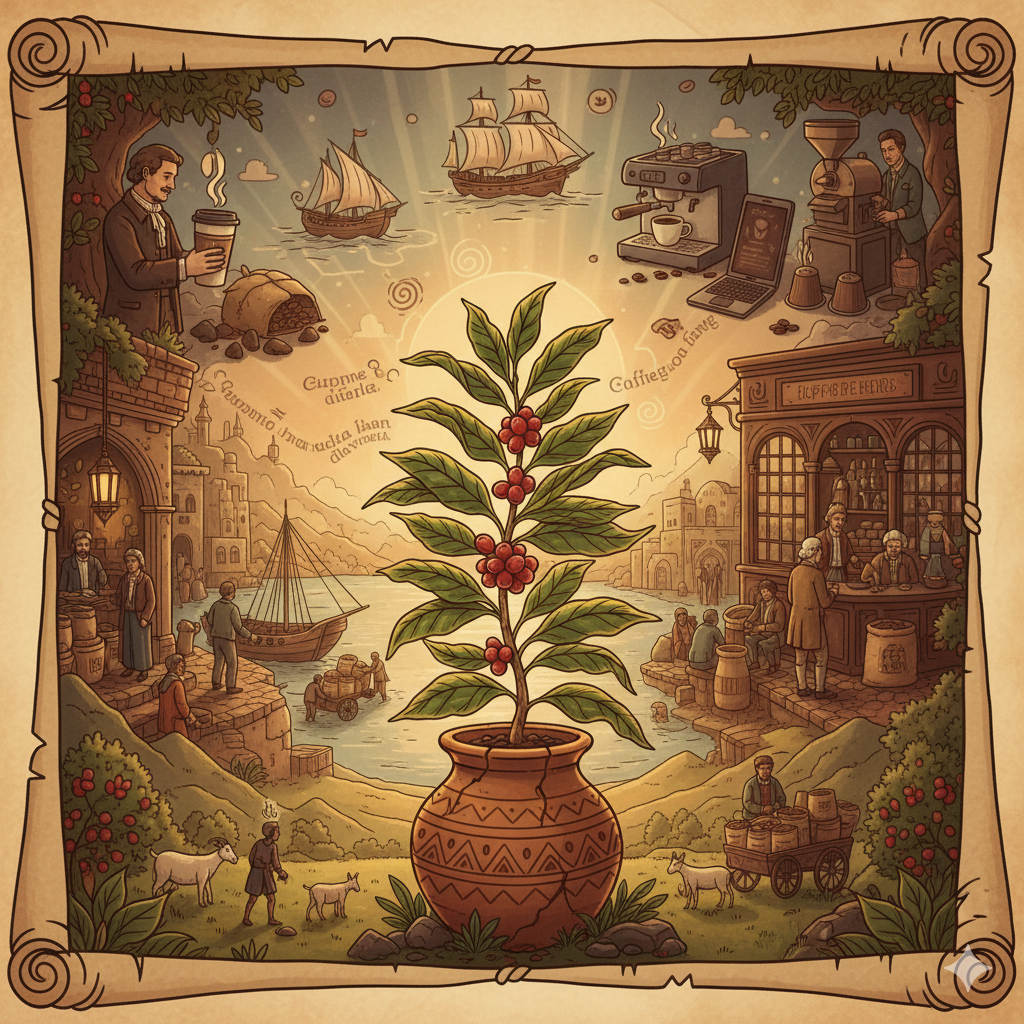
The story of coffee is a rich, centuries-spanning saga that began with a curious goat herder and grew into a $400 billion global industry. More than just a morning routine, coffee has fueled revolutions, inspired artists, and shaped societies.
The Legend of Kaldi and the Dancing Goats (Circa 850 AD)
The most popular and enduring legend of coffee’s discovery takes place in the ancient forests of Ethiopia.
The story goes that a goat herder named Kaldi noticed his flock acting strangely after eating bright red berries from a particular shrub. The goats became energetic, almost “dancing.” Curious, Kaldi tried the berries himself and experienced the stimulating effect. He shared his discovery with a local monastery. The monks, however, disapproved of the stimulating effects and tossed the berries into a fire, declaring them the Devil’s work.
Soon, the aroma of the roasting beans filled the air. This irresistible scent led the monks to rake the beans out, crush them, and mix them with hot water—creating the world’s first accidental cup of coffee.
The Spread to Yemen and the Birth of a Ritual (15th Century)
From Ethiopia, coffee beans were carried across the Red Sea to Yemen. This marks the true beginning of coffee cultivation and trade.
- Monopolization: Yemeni Sufi mystics were the first to systematically cultivate the plant. They found the drink useful for keeping them awake during long night prayers. For centuries, the port of Mocha (Al-Mukhā) in Yemen was the primary, and closely guarded, source of the world’s coffee supply.
- The Coffee House: By the 15th century, coffee had reached Mecca and Medina, and by the 16th century, it was widespread in the Middle East, Persia, Turkey, and North Africa. The coffee house (qahveh khaneh) became a vibrant social hub—places for playing chess, listening to music, discussing politics, and exchanging information. This revolutionary social dynamic led some authorities to temporarily ban the drink, fearing it fostered rebellious thought.
🚢 Coffee Goes Global: Europe and the Colonial Expansion (17th – 18th Centuries)
It was through global trade that coffee finally broke Yemen’s monopoly and conquered the world.
- Arrival in Europe: Coffee arrived in Europe via Venetian merchants in the early 17th century. Initially met with suspicion, it was eventually given the papal blessing by Pope Clement VIII, who supposedly found the drink too delicious to be unholy.
- The Age of Enlightenment: London’s coffee houses quickly became known as “penny universities”—you could buy a cup of coffee for a penny and listen to some of the brightest minds of the era debate literature, science, and philosophy. Institutions like the London Stock Exchange and Lloyd’s of London trace their origins back to these early coffee houses.
- Breaking the Monopoly: In the late 17th century, the Dutch managed to smuggle live coffee plants out of the Arab world and began large-scale cultivation in their colonies, primarily in Java (Indonesia).
- The Great Brazilian Heist: The most dramatic act of coffee expansion is attributed to a Brazilian officer, Francisco de Melo Palheta. In 1727, he was sent to French Guiana to mediate a border dispute. He wooed the governor’s wife, who, upon his departure, gifted him a bouquet containing hidden coffee seedlings. This illicit start launched Brazil into becoming the world’s largest coffee producer, a position it still holds today.
🏭 Modernization and the Two Giants
The 19th and 20th centuries saw innovation transform how coffee was consumed and marketed.
- Instant Coffee: Invented in various forms over the years, true commercial instant coffee was pioneered by George Constant Washington in 1906, revolutionizing convenience.
- The Espresso Machine: Developed in Italy in the late 19th and early 20th centuries, the espresso machine created a concentrated form of coffee, leading to the birth of classics like the cappuccino and latte.
- The Third Wave: Beginning in the late 20th century, the “Third Wave” coffee movement shifted focus from mass production to quality, sourcing, and craftsmanship. It emphasized single-origin beans, complex flavor profiles, and highly skilled baristas. This movement is what fuels today’s artisanal coffee culture.
From a handful of magical Ethiopian berries to a complex global commodity, coffee’s journey is a testament to the powerful allure of its flavor and the simple, universal need for a good energy boost.