

Introduction
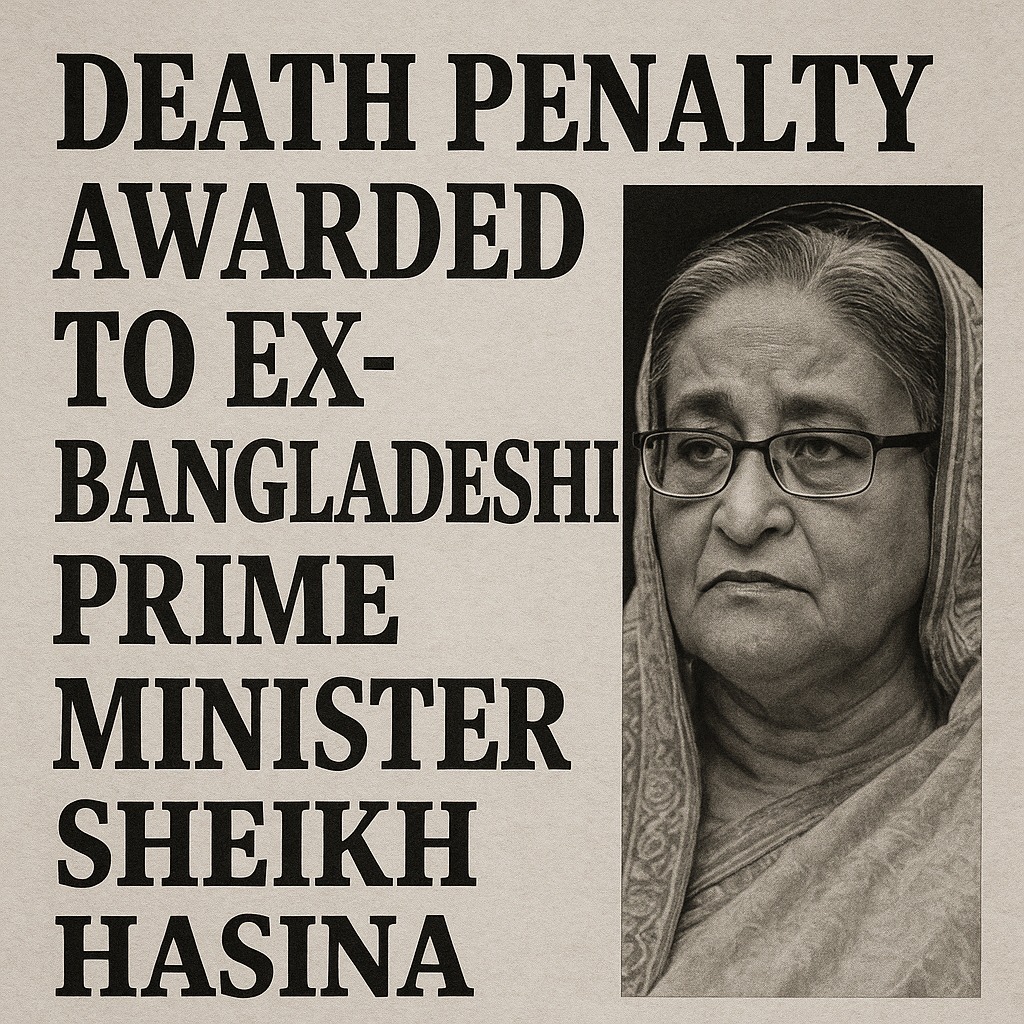
In a dramatic and unprecedented development, the International Crimes Tribunal (ICT) in Dhaka has sentenced former Bangladeshi Prime Minister Sheikh Hasina to death for crimes against humanity. The verdict, announced on 17 November 2025, links her directly to the deadly state crackdown on student-led protests in 2024. The judgment was delivered in absentia, as Hasina has been living in India since her government collapsed in August 2024.
The same tribunal also issued a death sentence for former Home Minister Asaduzzaman Khan, while the country’s former police chief received a prison sentence rather than capital punishment.
Background: The 2024 Protest Movement and Fall of the Government
The crisis traces its roots to June 2024, when massive student demonstrations erupted over the controversial government job quota system and growing frustration with Sheikh Hasina’s increasingly authoritarian governance style. What began as student protests quickly evolved into a nationwide uprising.
Human rights organizations, journalists, and eyewitnesses reported that security forces responded with:
- Live ammunition
- Snipers positioned on rooftops
- Drone surveillance and tear gas
- Widespread arrests and enforced disappearances
- Torture of political activists and protesters
According to multiple independent estimates, the crackdown resulted in over 1,400 deaths, including students, civilians, activists, and security personnel.
By August 2024, under immense public and international pressure, Sheikh Hasina resigned and fled to India. In her absence, renowned economist and Nobel laureate Dr. Muhammad Yunus was appointed to lead a caretaker government. The new administration released political prisoners, banned the Awami League for violent suppression, and ordered a formal investigation into the slaughter that unfolded during the protests.
How the Case Was Built: Charges and Evidence
The caretaker government empowered the ICT—originally established to investigate 1971 war crimes—to prosecute Hasina and key members of her administration for the 2024 crackdown.
The prosecution accused Sheikh Hasina of:
- Planning and authorizing mass killings
- Systematic use of state machinery to suppress political dissent
- Crimes against humanity, including murder, torture, and forced disappearances
- Failure to stop security forces, despite her full control over the chain of command
The tribunal reviewed:
- Eyewitness testimonies
- Leaked internal communications
- Government and military directives
- Video evidence of security forces firing on unarmed civilians
- A controversial leaked audio recording in which a voice resembling Hasina’s allegedly discussed having a “license to kill”
Hasina did not appoint a legal team to defend her and rejected the entire process, calling it politically motivated and illegitimate.
The Verdict: Death Sentence and Its Legal Implications
After months of hearings, the tribunal ruled that Sheikh Hasina:
- Directly oversaw and approved excessive use of force
- Failed to prevent atrocities committed under her leadership
- Was responsible for actions that legally qualify as crimes against humanity
She was sentenced to death by hanging, the standard execution method in Bangladesh.
Security forces across Dhaka were immediately placed on high alert. Curfew-like restrictions were implemented, and emergency orders were issued to prevent possible unrest by Awami League supporters.
Although there is a legal provision for appeal, Hasina’s refusal to engage with the judicial system—and her presence outside the country—makes any appeal unlikely.
Reactions: A Deeply Divided Nation
Supporters’ Perspective
Hasina’s supporters and the erstwhile Awami League leadership claim the conviction is:
- Politically motivated
- Driven by the caretaker government’s attempt to erase the Awami League from politics
- Based on biased evidence and one-sided testimonies
International observers have raised concern that the trial could be perceived as “victor’s justice”, where the victorious faction uses judicial tools to punish political rivals.
Opponents’ Perspective
Victims’ families, former protesters, and human rights activists praised the decision, calling it a historic step toward accountability.
To many who lost loved ones, the verdict symbolizes long-awaited justice for the violence inflicted during Hasina’s final term.
Regional and International Implications
The verdict has significant geopolitical consequences:
- India, where Hasina is currently staying, faces pressure to clarify whether it will continue providing her shelter.
- International human rights groups are divided—some welcome accountability, while others question the fairness of a trial held entirely in absentia.
- Bangladesh’s political future remains uncertain, as the country struggles to rebuild democratic institutions after years of repression.
Conclusion
The death sentence against former Prime Minister Sheikh Hasina marks one of the most consequential political and legal events in Bangladesh’s history. Whether viewed as long-delayed justice or politically charged retribution, the ruling will shape the nation’s political landscape for years to come.