

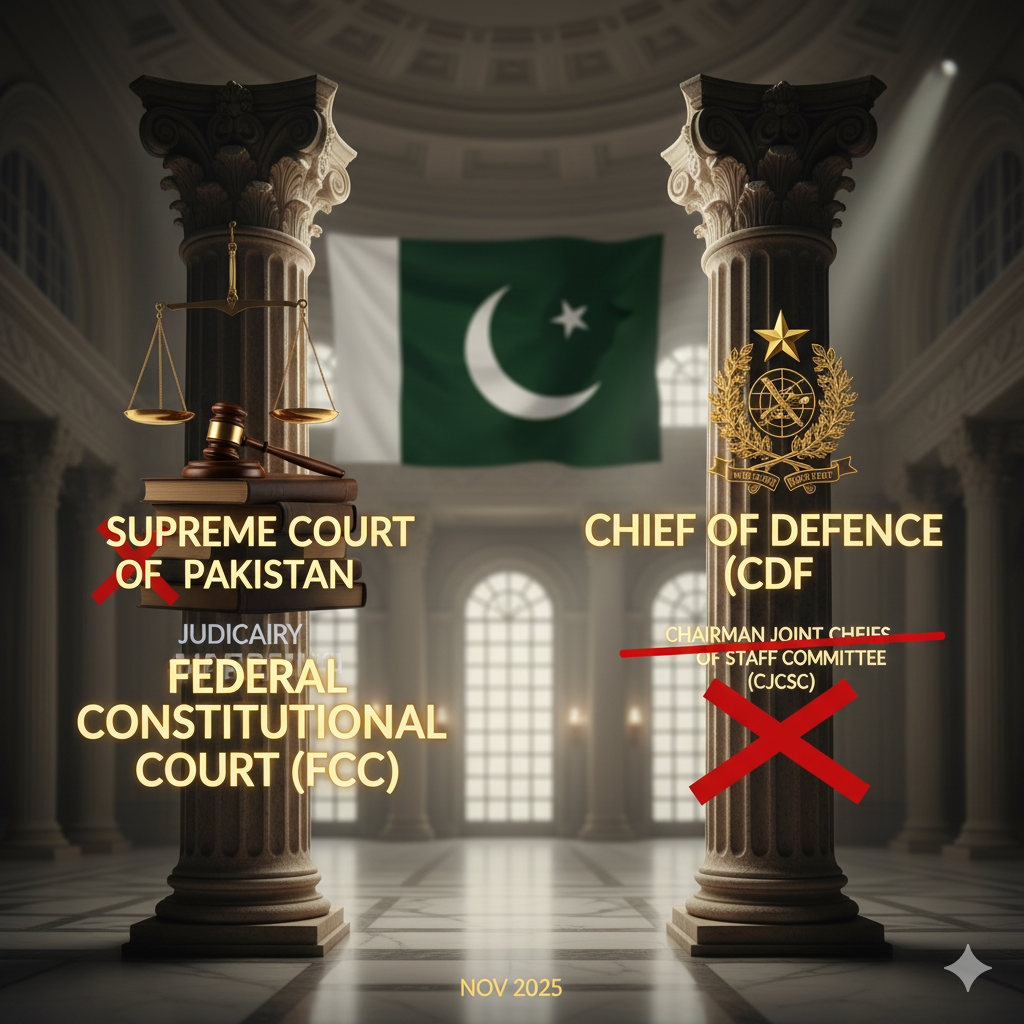
🚨 Introduction: A Major Turning Point in the Constitutional Structure
The 27th Constitutional Amendment (passed: November 2025) marks a significant milestone in Pakistan’s constitutional evolution. This amendment has directly affected the country’s two most critical pillars: the Judiciary and the Military Command. While the government maintains that these reforms will make the system more efficient, stable, and ready to meet modern challenges, the opposition and legal experts have called it a major assault on the basic constitutional balance and democratic principles.
⚖️ Part I: Judicial Reorganization and Transfer of Authority
This amendment introduces one of the most substantial changes to Pakistan’s judicial structure, centered around the establishment of a new court.
1. Establishment of the Federal Constitutional Court (FCC)
The central element of the 27th Amendment is the creation of a new Federal Constitutional Court (FCC).
- Reduction in Supreme Court Powers: Under the amendment, the Supreme Court of Pakistan has been stripped of the ultimate authority to interpret the Constitution and hear all federal constitutional cases. The Supreme Court will now primarily function as a general Appellate Court, confined to hearing civil, criminal, and ordinary legal appeals.
- Abolition of Article 184(3): The Supreme Court’s power of Suo motu notice (Article 184(3) of the Constitution) in matters of public importance has also been deleted. This power may now fall under the jurisdiction of the FCC, significantly reducing the institutional power and political influence of the apex court.
- Representation of Federalism: The FCC is mandated to have equal representation from all provinces. The stated goal is to give greater weight to the perspectives of the federating units in constitutional matters and resolve provincial disputes more effectively.
2. Controversial Provisions Regarding Judicial Transfers
The amendment also introduced controversial changes regarding the transfer of judges:
- High Court Judges’ Transfer: The authority to transfer High Court judges is given to the Judicial Commission of Pakistan (JCP). The most crucial and contentious clause is that if a judge refuses to accept a transfer, they shall be deemed to have retired, and a reference will be filed against them in the Supreme Judicial Council.
- Questions of Intent: Critics have labeled this clause as a tactic for governments to remove “undesirable” judges, potentially undermining judicial independence.
🛡️ Part II: Fundamental Changes in Military Command
The 27th Amendment has also brought about historic constitutional changes in the structure of the Armed Forces’ command.
1. The New Post of Chief of Defence Forces (CDF)
- Abolition of CJCSC Post: The ceremonial post of Chairman Joint Chiefs of Staff Committee (CJCSC) has been abolished, effective November 27, 2025.
- Dual Role of the Army Chief: The Chief of Army Staff (COAS) will now simultaneously hold the position of Chief of Defence Forces (CDF). Through this new position, the CDF will exercise constitutional command over all three forces: Army, Navy, and Air Force.
- National Strategic Command: The CDF’s influence over the country’s nuclear assets and strategic command has also increased, further constitutionally solidifying the central role of the military in the national defence structure.
2. Lifetime Honours and Immunities
- Lifetime Ranks: Honorary five-star ranks such as Field Marshal, Marshal of the Air Force, and Admiral of the Fleet will now carry lifetime status and privileges, requiring a two-thirds majority of Parliament to abolish them.
- Lifetime Immunity for the President: The President of Pakistan has been granted lifetime immunity from criminal proceedings and arrest even after leaving office, seen by many as a parallel move to constitutionalize immunity across the highest levels of the state.
🗣️ Concluding Analysis: Democratic and Constitutional Crisis?
The 27th Constitutional Amendment, while being touted as an attempt to introduce efficiency into the system, is simultaneously viewed as a monumental step in the history of Pakistan’s civil-military balance.
- Critics’ Viewpoint: Legal experts argue that judicial independence has been completely crippled by stripping the Supreme Court of constitutional powers and tightening the rules for judges’ transfers. The constitutional grant of virtually absolute authority to the CDF in the military structure is seen as a blow to democracy, further entrenching the concept of military supremacy within the Constitution.
- Supporters’ Viewpoint: The government and allied parties argue that the FCC will reduce the Supreme Court’s workload and resolve constitutional matters in a more transparent and merit-based manner. The CDF position is intended to ensure better coordination and unity of command among defence institutions.
Conclusion: The 27th Constitutional Amendment will have long-term effects on the Pakistani constitutional, political, and legal landscape. It remains to be seen how the new Federal Constitutional Court maintains the standard of justice and whether these changes bring stability or deepen the constitutional debate in the country.
What is your opinion? Do you believe the 27th Amendment will strengthen the Constitution or compromise judicial independence? Share your thoughts in the comments.