

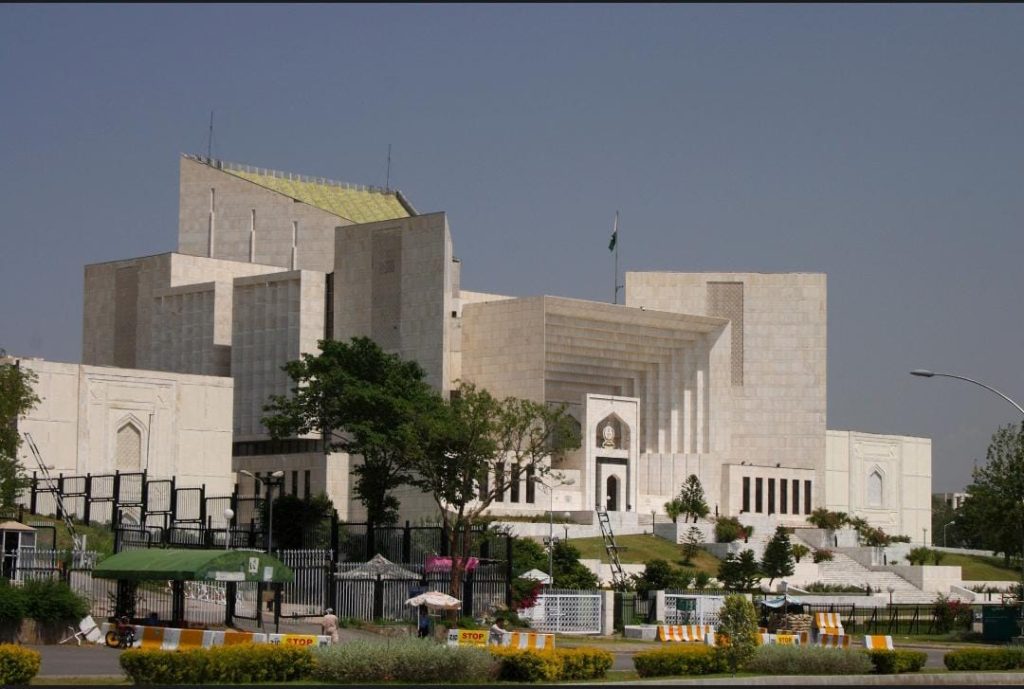
The Supreme Court of Pakistan (SCP) is the apex and highest judicial institution in the Islamic Republic of Pakistan. It serves as the final arbiter of constitutional and legal disputes in the country and is responsible for the ultimate interpretation of constitutional law. It is the highest appellate court in the country.
🏛️ Basic Status and Structure
- Constitutional Basis: The Supreme Court was established under Chapter VII of the Constitution of Pakistan.
- Composition: The Supreme Court comprises the Chief Justice of Pakistan and a specified number of other judges as determined by the Constitution. The Constitution allows Parliament to fix the determined number of judges. Judges are appointed through the Judicial Commission of Pakistan.
- Tenure of Judges: Judges of the Supreme Court hold office until they reach the age of 65 years, unless they resign earlier or are removed according to the Constitution.
- Principal Seat: The permanent seat of the Supreme Court is located in Islamabad.
⚖️ Jurisdiction
The Supreme Court possesses vast and ultimate powers, which can be broadly categorized into three types:
- Original Jurisdiction:
- It can directly hear cases involving a dispute between two or more provinces or the Federal Government.
- It can also take direct action in matters of public importance regarding the enforcement of fundamental rights (Article 184(3)), also known as Suo Moto Action.
- Appellate Jurisdiction:
- It hears appeals against the judgments of the High Courts of Pakistan. It is the final court of appeal in criminal, civil, and constitutional matters.
- Advisory Jurisdiction:
- The President of Pakistan may seek the Court’s opinion on any legal question deemed to be of public importance.
👨⚖️ Role of the Supreme Court
- Interpreter of the Constitution: The Supreme Court is the ultimate interpreter of the Constitution. Its decision is final regarding the country’s laws and constitutional matters.
- Guardian of Fundamental Rights: It acts as the guardian of the fundamental rights of the country’s citizens and ensures their protection.
- Judicial Independence: The Constitution grants the Supreme Court powerful judicial independence to prevent unconstitutional legislation by Parliament or the exercise of executive power by the Prime Minister.
- Principle of Precedent: The decisions of the Supreme Court are binding as precedent on all other courts in the country (including High Courts, District, and Special Courts).
📜 Eligibility of Judges
According to Article 177(2) of the Constitution, a person must meet the following qualifications to become a Judge of the Supreme Court:
- They must be a citizen of Pakistan.
- They must have at least 5 years of experience as a judge of a High Court.
- Or, they must have at least 15 years of experience as an Advocate of a High Court.